Trex Transcend vs. TimberTech Premium: A Cincinnati Builder’s Honest Comparison
If you have been comparing composite decking brands, you have probably noticed something frustrating. Most of what you find online comes from a dealer who sells one brand, a manufacturer's own site, or a national review roundup written by someone who has never carried a deck board up a hill in July. As a deck contractor in Cincinnati who installs both Trex and TimberTech, we see the two brands side by side on real jobs, in real Ohio weather, on real budgets. This comparison focuses on the premium tiers, Trex Transcend and TimberTech's upper lines, because that is where the color, texture, and durability differences actually show up.
Neither brand is a bad choice. Both make better deck boards than the composite products of fifteen years ago, and both hold up to Cincinnati's freeze-thaw winters far better than a stained wood deck that needs recoating every two or three seasons. The honest answer to "which composite decking brand is best" depends on what you care about most: color depth, scratch resistance, heat underfoot, or how the board edge finishes out. Here are eight points of comparison, from a builder who has no reason to steer you either way.
1. The Core Material Is the Biggest Technical Difference
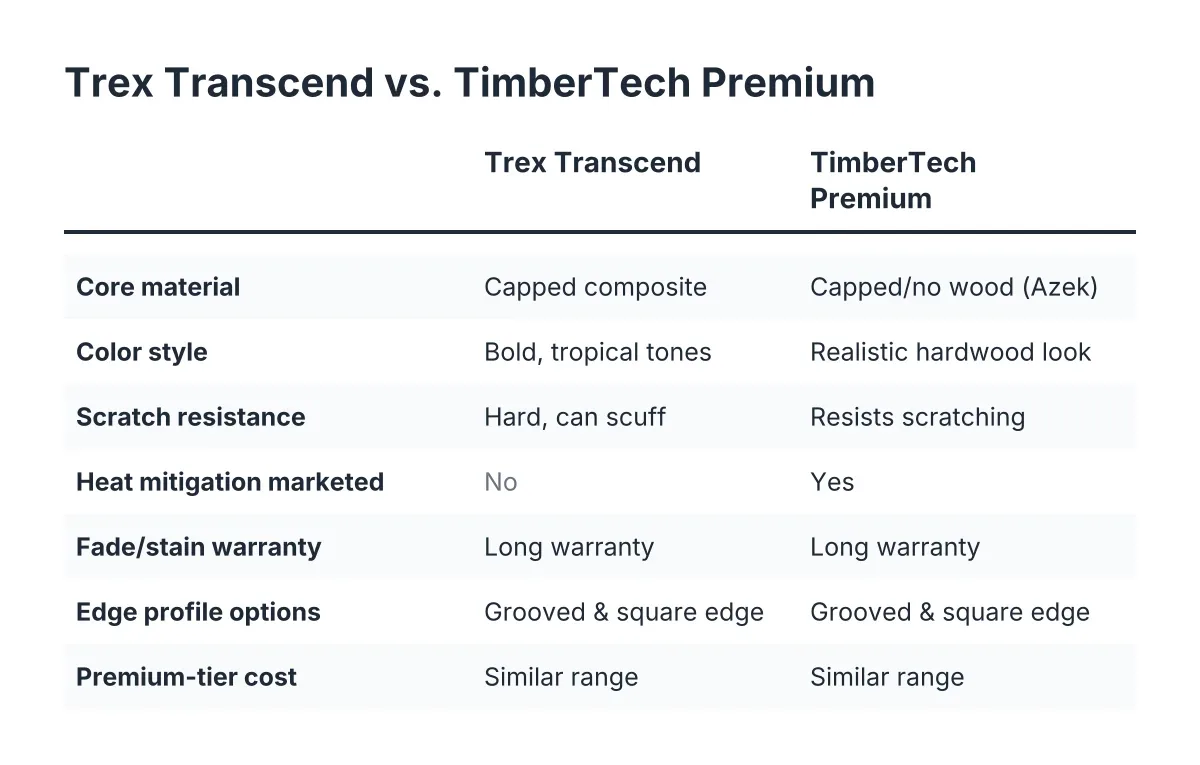
Trex Transcend is a wood-plastic composite with a protective cap on three sides. TimberTech's premium lines include both capped composite and a fully capped polymer board called TimberTech Azek, which contains no wood fiber at all. That matters in Cincinnati because our summers are humid and our winters cycle through freeze and thaw repeatedly. A board with no wood content has less to absorb moisture in the first place, while a capped composite relies on its shell to keep water out. Both approaches work when installed correctly; they just manage moisture differently.
2. Color Depth and Composite Decking Brand Aesthetics: Trex Rustic vs. TimberTech Realistic
Trex Transcend colors tend toward rich, tropical-inspired tones with heavy streaking, shades like Spiced Rum and Island Mist that read as warm and varied. TimberTech's premium decking colors push harder toward mimicking real hardwood, with cathedral grain patterns and subtler color blending that can fool people into thinking the deck is ipe or walnut. Neither is better; it is a taste question. If you want a deck that announces itself, Trex's bolder palettes do that. If you want guests to ask whether it is real wood, TimberTech's top lines get closer.
3. Scratch Resistance Matters More Than Most Brochures Admit
Every composite board can scratch; dragging a cast-iron fire pit or a loaded grill across either brand will leave a mark. In practice, TimberTech's fully capped polymer boards resist surface scratching better than most capped composites, while Trex Transcend's shell is hard but can show scuffs from heavy furniture. For a homeowner planning a hot tub, an outdoor dining set, or a grill station, this is worth weighing. Felt pads and furniture glides solve most of it, but the brand difference is real, and no single-brand dealer page will tell you that.
4. Heat Underfoot Is a Cincinnati Summer Question
Dark composite boards get hot in direct August sun, regardless of brand. Lighter colors in both lines stay noticeably more comfortable for bare feet, which matters on a pool deck or a south-facing backyard. TimberTech markets heat mitigation in some of its premium polymer boards, and in our climate that can make a difference on a pool deck installation with full afternoon exposure. The simpler rule holds for both composite decking brands: if your deck bakes in the sun, pick a lighter color before you pick a brand.
5. Fade and Stain Warranties Are Close, but Read the Fine Print
Both manufacturers back their premium lines with long fade-and-stain warranties, and both have earned decent reputations for honoring them. The differences live in the details: what counts as fade, how claims are measured, and whether labor is covered. However, warranty paper only matters if the deck is built to spec. Improper joist spacing, bad drainage, or skipped ventilation can void coverage from either brand. This is one place where the installer matters as much as the board, and where a deck builder familiar with both systems protects your investment.
6. Edge Profiles and Finishing Details Separate a Good Deck From a Great One
Both brands sell boards in two edge profiles: grooved-edge boards for hidden fasteners, and square-edge boards for picture-frame borders and stair treads. A picture-frame border, where a contrasting board wraps the deck perimeter, is one of the clearest visual upgrades that separates a professional build from a basic platform. According to Trex, composite systems include color-matched plugs that cover screw heads on those border boards, so the fasteners disappear. The takeaway for your quotes: ask every deck contractor what finishing style is included. Fascia treatment, borders, and hidden fasteners affect cost independent of which brand you choose.
7. Cost Runs Close at the Premium Tier, and Size Is the Real Lever
At the top tiers, the cost of Trex decking and TimberTech's premium lines lands in a similar range, close enough that brand alone rarely decides a budget. The bigger tradeoff is size versus material grade. A fixed budget forces a choice: a larger deck in a mid-tier board, a smaller deck in a premium board, or paying more for both. For national context on composite deck cost, the Remodeling 2024 Cost vs. Value Report puts a 16'x20' composite deck at an average of $24,206 with a 68% return at resale, versus $17,615 and 83% for pressure-treated wood. Resale math favors wood; daily living and low maintenance favor composite. If you are selling soon, that gap matters. If you are staying ten years, it mostly does not.
Suppose a homeowner in Anderson Township has a budget that covers a 350-square-foot premium composite deck or a 450-square-foot mid-tier deck. In that scenario, the right call depends on how they will use the space. A couple who entertains eight people most weekends probably needs the square footage. A couple adding a hot tub and a small seating area is better served by the tougher premium board under heavy furniture.
8. Both Composite Decking Brands Handle Ohio Weather, if the Frame Underneath Does
Here is the part most brand comparisons skip entirely: the composite board is the last thing that fails on a Cincinnati deck. The frame fails first. Both Trex and TimberTech ride on a pressure-treated wood structure, and that structure faces our freeze-thaw cycles, frost-depth footing requirements, and humid summers. A few framing details matter regardless of which brand goes on top:
- Footings dug below frost depth, per the Hamilton County or city permit requirements for your address
- Waterproofing tape over joist tops, a moisture measure professional builders add even though treated lumber resists rot on its own, according to TimberTech
- Hot-dip galvanized or stainless fasteners, which the American Galvanizers Association notes are needed to resist corrosion from copper-based treatment chemicals
- Heavier zinc-coated hangers and connectors, such as ZMAX-rated hardware, per Simpson Strong-Tie
A premium board on a cut-rate frame is a thirty-year surface on a fifteen-year structure. When you compare quotes, ask what is under the deck, not just on top of it.
So Which Brand Should You Pick?
For most greater Cincinnati homeowners, the trex vs timbertech decision comes down to three questions. Do you want bold, streaked color or realistic hardwood grain? Will heavy furniture, a grill, or a hot tub live on the deck? And is the surface temperature on a sun-exposed pool deck a concern? Answer those, and the brand usually picks itself. Trex Transcend wins on color personality and broad availability. TimberTech's premium polymer lines win on scratch resistance, moisture performance, and wood realism.
What neither brand can do is overcome a weak design or a rushed install. A multi-level deck, a deck and patio combination, or a screened-in porch each puts different structural demands on the frame and different wear patterns on the surface. If your yard slopes, your HOA has setback rules, or your project needs a Hamilton County permit, it is worth talking through the plan with a local deck builder before you commit to a board. Both brands reward a careful build. Pick the one that fits how you live outside, then make sure the structure underneath earns the board on top.
If you need deck building and installation, Cincinnati Deck Pros can help.
Prefer to talk it through? Call (513) 613-3364 — a quick call is usually the fastest way to get a straight answer for your situation.