Hiring a Deck Builder — Complete Guide
Hiring a deck builder is a bigger decision than picking the lowest bid, and most Cincinnati homeowners only learn that after something goes wrong. Whether you were oversold last time, ghosted mid-project, or handed a deck that heaved after one Ohio winter, this guide gives you a vetting process built to prevent a repeat. You'll learn how to screen deck builders near me search results, what licensing and insurance actually prove, which red flags predict trouble, and how to compare quotes line by line. By the end, you'll know exactly which questions to ask before you sign anything.
What You'll Find in This Guide
Coming soon — we're building out this topic cluster.
Searching "Deck Builders Near Me": Why Local Specialists Beat Generalists
Type deck builders near me into Google and you'll see three kinds of results: national lead-gen directories, general contractors who list decks among a dozen services, and true deck specialists. The differences matter more than most homeowners realize.
Lead-gen directories sell your contact information to multiple contractors. As a result, you get a flood of calls from companies that paid for your name, not companies that earned your attention. You also lose control of the vetting process before it starts.
General contractors can build a competent deck. However, decks are a structural specialty with their own failure modes. According to the International Association of Certified Home Inspectors, as many as 60 percent of the roughly 45 million deck structures in America have safety issues, and about 90 percent of deck collapses stem from ledger board connection failures. That ledger connection, where the deck attaches to your house, is exactly the detail a builder who frames decks every week gets right and an occasional deck builder gets wrong.
Local Deck Builders Near Cincinnati: What Knowledge Looks Like
Beyond structural specialization, Cincinnati adds its own layer of requirements. Ohio's freeze-thaw cycles push and heave shallow footings, so posts here need to sit below the local frost depth. A builder who works in Hamilton County constantly will know that number without looking it up. They'll also know the permit path, because permitting differs depending on whether your home falls under Hamilton County jurisdiction or a city like Cincinnati, Blue Ash, or Mason with its own building department.
With this in mind, test any contractor on local specifics during your first call. Ask how deep they set footings for our frost line. Ask which office issues the permit for your address.Additionally, ask whether your neighborhood's setback rules or HOA covenants affect deck placement. A specialist answers immediately and in detail. A generalist hedges, and that hedge tells you everything.
For an industry-level view of deck safety and builder standards, the North American Deck & Railing Association publishes consumer resources worth reviewing before you interview anyone.
Deck Contractor Licensing, Insurance, and the Red Flags That Predict Problems
Licensing and insurance are the floor, not the ceiling. That said, plenty of homeowners skip verifying either one, and it's the cheapest protection available to you.
Start with insurance, because it protects you directly. Ask every contractor for a certificate of general liability insurance and proof of workers' compensation coverage. Then call the insurance carrier to confirm the policy is active. This takes five minutes. If a worker gets injured on your property and the contractor lacks workers' comp, you can end up liable. Similarly, if an uninsured crew damages your home, you're negotiating with someone who has nothing to lose.
Next, confirm registration and permitting habits. In the Cincinnati area, contractors doing structural work typically need to register with the local building department that covers your address. More importantly, ask who pulls the permit. The correct answer is the contractor, in their name. A builder who asks you to pull the permit as a homeowner is shifting liability onto you, and often signaling they can't pull permits themselves.
Red Flags That Should End the Conversation
Some warning signs are subtle, but most are not. Watch for these:
- Large upfront deposits, especially requests for half or more before materials arrive
- Pressure tactics, such as a price that expires today or a discount for signing on the spot
- No written contract, or a vague one-page contract with no scope, materials, or timeline
- Cash-only payment or reluctance to provide a receipt
- No local references, or references they won't let you contact
- Suggesting you skip the permit to save time or money
- A quote dramatically below every other bid with no explanation
That last one deserves emphasis. For example, a bid that comes in 30 percent under the field usually means undersized footings, cheaper fasteners, no permit, or a change-order strategy that recovers the difference after demolition starts. In practice, the lowball bid is rarely the deal it appears to be.
Conversely, note the green flags: itemized proposals, willingness to walk you through the framing plan, photos of past ledger and footing work, and a permit history you can verify with the building department.
How to Compare Deck Quotes and Ask the Questions That Reveal a Builder's Character
Once you've screened out the obvious risks, you'll likely hold two or three quotes that look nothing alike. Comparing them fairly requires normalizing what each one includes, because contractors rarely quote the same scope the same way.
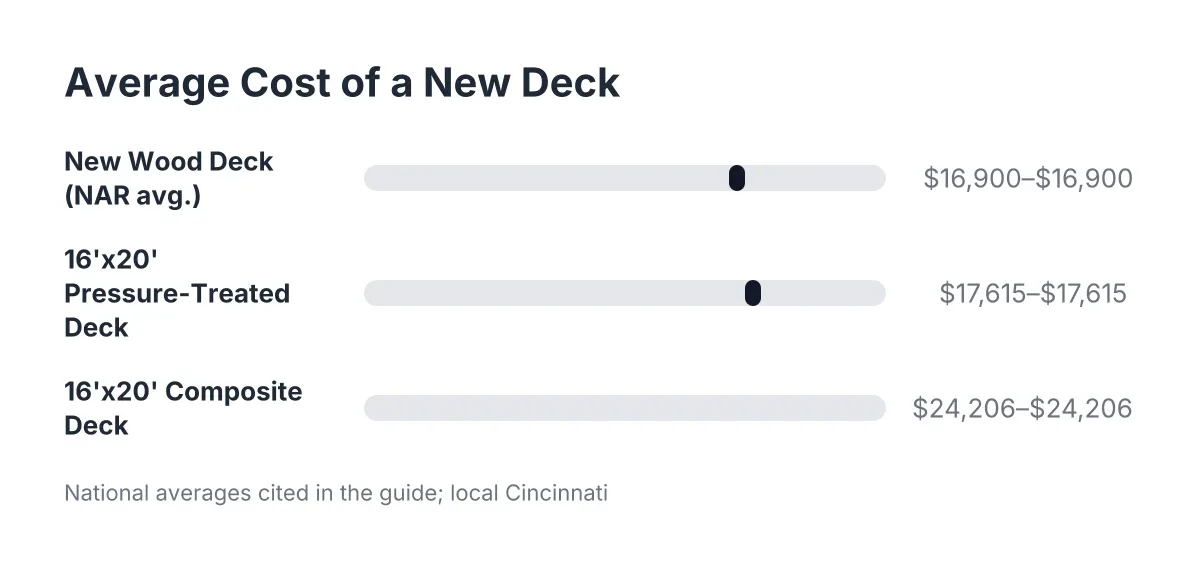
First, anchor your expectations. NAR's 2023 Remodeling Impact Report found the average cost of a new wood deck project was $16,900 nationally. Meanwhile, the Remodeling 2024 Cost vs. Value Report puts a 16'x20' pressure-treated deck at an average of $17,615 with an 83% ROI, and the same deck in composite at $24,206 with a 68% ROI. Your Cincinnati numbers will vary with size, site conditions, and railing choices. Still, these figures give you a sanity check when a bid lands far outside the range.
Line Items Every Quote Should Break Out
To compare quotes accurately, insist each proposal itemizes the following. Otherwise you're comparing a sedan to a truck by sticker price alone.
- Footing count, diameter, and depth relative to frost line
- Framing lumber grade and joist spacing
- Decking brand and product line, not just "composite" (Trex Transcend and TimberTech AZEK behave and price very differently)
- Ledger attachment and flashing details
- Railing system and materials
- Permit fees and who files
- Demolition and haul-away, if replacing an existing deck
- Payment schedule tied to milestones, not dates
Additionally, ask each builder the same set of questions so you can compare answers directly. Who is on site daily, an employee crew or subcontractors? How do you handle change orders, and what do they cost? What does your warranty cover on labor versus materials? Can I visit a deck you built five or more years ago? That last question matters most, because a five-year-old deck shows how the builder's work handles Ohio winters.
Finally, pay attention to how each contractor responds to scrutiny. A trustworthy builder welcomes detailed questions and answers them without defensiveness. If asking about footing depth or flashing makes someone bristle, imagine how a mid-project dispute will go. The quote comparison isn't just about price. Rather, it's your best preview of what working with each candidate will actually feel like.
Repair, Resurface, or Rebuild: Deciding What Your Existing Deck Actually Needs
Not every project starts from scratch. If you already own a deck, the first honest conversation with a contractor should cover whether it needs repair, resurfacing, or full replacement. This is also where trust matters most, because an unscrupulous builder can steer you toward the most expensive option regardless of what your deck needs.
The scale of the problem is real. The North American Deck & Railing Association estimates there are about 30 million decks in the United States that are beyond their useful life and require repair or replacement. Consequently, many Cincinnati homeowners searching for nearby deck builders and specialists actually need an evaluation before they need a bid.
Here's a rough framework. If your framing is sound but boards are splintered, faded, or cupped, resurfacing may work. That means keeping the substructure and replacing the walking surface and railings, often upgrading to composite. However, resurfacing only makes sense if the joists, beams, posts, and ledger pass inspection. If footings have heaved from freeze-thaw cycles, if the ledger shows rot or improper flashing, or if joists are soft when probed, a rebuild protects you better than a cosmetic fix.
How an Honest Contractor Handles the Assessment
Watch how a builder inspects your existing deck. A thorough contractor crawls underneath, probes framing with a screwdriver, checks the ledger flashing, and photographs what they find. Then they show you the photos and explain the reasoning behind their recommendation. By contrast, a contractor who glances at the surface and immediately quotes a full teardown, or who promises resurfacing without ever looking at the framing, is guessing or selling.
Ask for the recommendation in writing with the evidence attached. Additionally, get a second opinion when the verdict is expensive. A legitimate builder won't fear a second set of eyes, because their assessment holds up. That confidence, more than any sales pitch, is the mark of a contractor you can hand your project to.
Ready to Get Started?
You now have a vetting framework built around the exact ways homeowners get burned: unverified insurance, vague quotes, lowball bids, and upsold rebuilds. If you're planning a new deck, porch, or patio in the Cincinnati area, we'd welcome the chance to answer every question on this list, including the hard ones. Reach out for an honest assessment and an itemized quote you can compare against anyone.