Deck Resurfacing and Rebuilding — Complete Guide
If your deck looks worn but you're not sure whether it needs new boards or a full teardown, you're facing one of the most expensive judgment calls in home ownership. The gap between a resurfacing project and a structural rebuild can run into five figures, so understanding your real deck repair cost before you sign anything matters. This guide gives you an honest framework for telling the two apart, drawn from years of inspecting aging decks across Cincinnati and Hamilton County. You'll learn the structural signs that decide the question, what each path actually costs, and how Ohio's freeze-thaw climate tips the scale. No upsell, no scare tactics, just the same checklist we use on real inspections.
What You'll Find in This Guide
Coming soon — we're building out this topic cluster.
How to Tell Whether Your Deck Needs New Boards or a New Frame
The single most important question in this decision has nothing to do with how your deck looks. Instead, it comes down to the condition of the structure underneath: the posts, beams, joists, and the ledger board that ties the deck to your house. Surface boards and railings take the worst of the sun and rain, so they often fail decades before the frame does. When that happens, resurfacing makes sense. You keep the sound frame, strip off the tired decking, and install new boards on top.
However, the reverse is also common. Plenty of decks in Cincinnati have decent-looking boards sitting on a frame that's quietly rotting from the inside. According to the North American Deck & Railing Association, roughly 30 million decks in the United States sit beyond their useful life and need repair or replacement. Many of their owners have no idea, because the damage hides where nobody looks.
The Ground-Level Inspection That Settles It
Before you price anything, get under the deck with a flashlight and a screwdriver. Probe the ledger board where it meets the house. If the tip sinks in easily, water has been getting behind the flashing, and that's a structural problem no new boards will fix. Next, check each post at ground level. Posts set in or on concrete tend to rot right at the base, especially after decades of Ohio freeze-thaw cycles pushing moisture into the end grain.
Then look at the joists from below. Dark streaks, soft spots, and fasteners weeping rust all signal trapped moisture. A few compromised joists can sometimes be sistered or replaced as part of a resurfacing project. But widespread joist rot, a failing ledger, or heaving footings point clearly toward a rebuild.
Finally, stand on the deck and bounce gently near the center. Noticeable sway or movement usually means loose connections or undersized framing. As a result, a deck that moves under your feet almost never qualifies for a simple resurface, no matter how good the boards look. The honest rule we follow: resurface when the frame passes inspection, rebuild when it doesn't, and never bury a bad frame under expensive new decking.
What Drives the Costs of Deck Repair vs. Rebuild
Once you know which path your deck qualifies for, the money question comes into focus. To put it simply, resurfacing costs less because you're only buying materials and labor for the walking surface and usually the railings. A rebuild means demolition, hauling, new footings, new framing, new decking, new railings, and often a new permit. That's why the two projects can differ so dramatically in price even on the same footprint.
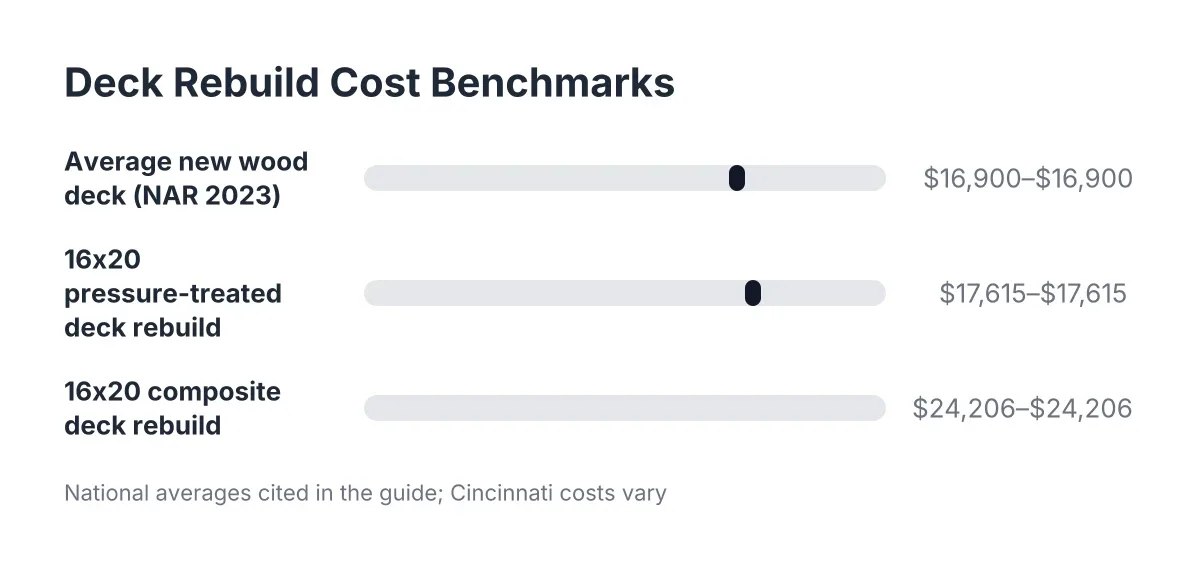
For context on the rebuild side, NAR's 2023 Remodeling Impact Report found the average cost of a new wood deck project was $16,900 nationally. Meanwhile, the Remodeling 2024 Cost vs. Value Report puts a 16-by-20 pressure-treated deck at an average of $17,615, and the same deck in composite at $24,206. Your Cincinnati numbers will vary with size, height, site access, and material choice. Still, those figures give you a realistic anchor for what "full rebuild" means before you compare bids.
Where Resurfacing Saves Money and Where It Doesn't
Resurfacing typically runs a fraction of rebuild pricing because the frame, footings, and demolition of the substructure drop out of the equation. However, the savings shrink fast if the inspection turns up hidden framing repairs. For example, replacing several joists, re-flashing a ledger, and rebuilding stairs can push a resurfacing quote uncomfortably close to rebuild territory. At that point, most homeowners are better served putting the money into a new frame built to current code.
There's also a long-game consideration. If you resurface a 25-year-old frame with premium composite boards rated for 25 to 50 years, the frame will fail long before the decking does. This means you'd eventually pay to demolish and rebuild anyway, and the beautiful boards come off with everything else. With this in mind, we generally recommend composite resurfacing only on frames with plenty of structural life left. Weigh your deck repair cost against the remaining lifespan of what's underneath, not just against the rebuild quote sitting next to it.
The upside works in both directions, though. According to the National Association of Realtors, decks earned a joy score of 9.8 out of 10 in the Remodeling Impact Report, and 81% of homeowners say they enjoy their homes more after adding a deck. Either path gets you back outside; the frame decides which one is honest.
How Cincinnati Weather and Permits Change the Decision
National advice on deck resurfacing versus replacement often skips the factors that matter most here. Cincinnati sits in a genuine freeze-thaw climate. Water gets into wood and concrete, freezes, expands, and pries things apart, then repeats the cycle dozens of times each winter. Consequently, decks age differently here than they do in Phoenix or Atlanta, and the inspection standards should reflect that.
Footings are the clearest example. Ohio code requires deck footings to extend below the local frost line, because shallow footings heave when the ground freezes. If your older deck sits on surface blocks or shallow piers, you may see posts that have lifted, racked railings, or gaps opening at the ledger. In that case, resurfacing would only dress up a foundation problem. A rebuild lets you set proper frost-depth footings and stop the movement for good.
Permits, HOAs, and What a Rebuild Triggers
Here's a practical wrinkle many homeowners miss. Resurfacing an existing deck, where you replace boards and railings on the same frame, usually doesn't trigger a new building permit. However, a full rebuild in Hamilton County or the City of Cincinnati typically does, along with inspections of the footings and framing. That's not a reason to avoid rebuilding. In fact, the permit process protects you, because an inspected frame built to current code is exactly what you want holding up your family and guests. It simply means a rebuild takes more lead time, so plan your season accordingly.
Additionally, if you live in a neighborhood with an HOA, check the rules before committing to either path. Some associations restrict decking colors, railing styles, or footprint changes. A resurface that keeps the same footprint rarely raises objections. A rebuild that expands the deck or adds a second level might require approval, and setback rules can limit how far you extend toward property lines.
Material choice rounds out the local picture. Because of our climate, composite brands like Trex and TimberTech have become the default recommendation for resurfacing projects here. They shrug off the moisture cycling that destroys wood boards, and they eliminate the staining-and-sealing routine that Ohio humidity makes an annual chore. For rebuilds, the same logic applies to the surface, while pressure-treated lumber remains the standard for the frame beneath it.
Ready to Get Started?
If you're staring at a worn deck and second-guessing every quote you've received, get a straight answer from a Cincinnati specialist who inspects the frame before recommending anything. We'll tell you honestly whether resurfacing will hold up or whether a rebuild is the smarter spend, and we'll price both paths so you can decide with real numbers. Reach out to schedule an on-site inspection, and let's figure out what your deck actually needs.