Deck Staining and Sealing — Complete Guide
Your deck fights a harder battle in Cincinnati than in most of the country. Between Ohio River valley humidity, 40-plus freeze-thaw cycles each winter, and summer sun that bakes bare boards, an unprotected wood deck here can look ten years old after three. This guide covers deck staining and sealing as a maintenance strategy tuned to Hamilton County weather, not generic national advice. You will learn why our climate is uniquely tough on wood, how deck staining sealing differ from each other, how often to redo each, and what a realistic maintenance schedule looks like. By the end, you will know exactly what your deck needs this year and when to schedule it.
What You'll Find in This Guide
Coming soon — we're building out this topic cluster.
Why Deck Staining and Sealing Matters in Cincinnati
Wood decks fail from the outside in. Water soaks into unsealed boards, and in Cincinnati that water rarely gets a chance to leave. Our region averages high humidity from May through September, so damp boards stay damp. Then winter arrives, and the real damage starts.
The Freeze-Thaw Problem
Cincinnati sits in a freeze-thaw belt. Temperatures cross the freezing line dozens of times each winter, often several times in a single week. Every crossing matters for your deck. Water trapped inside the wood freezes, expands by roughly nine percent, and pries the grain apart. Then it thaws, sinks deeper into the new cracks, and freezes again. As a result, unprotected boards develop the checking, cupping, and splintering you see on neglected decks all over Hamilton County. A good penetrating stain and sealer blocks that water at the surface, which breaks the cycle before it starts.
Humidity, Shade, and Mildew
Beyond freeze-thaw damage, our summer humidity feeds mildew and algae. Shaded decks are the worst offenders. If your deck sits under mature trees in Hyde Park, Anderson Township, or Wyoming, the north-facing boards likely stay damp until noon. That moisture turns into green or black staining, and it makes the surface dangerously slick after rain. Stains with mildewcide additives fight this directly, and proper deck sealing keeps spores from rooting into open grain.
Protecting a Real Investment
This maintenance matters because your deck represents real money. According to the Remodeling 2024 Cost vs. Value Report, a new 16-by-20 pressure-treated wood deck costs an average of $17,615 and recoups about 83% of that at resale. However, that resale figure assumes the deck looks and performs well. A gray, splintered, water-damaged deck does the opposite for a buyer. In practice, a few hundred dollars of stain every two to three years protects a five-figure asset. That math works out in your favor every single time.
Deck Sealing vs. Staining: What Each One Actually Does
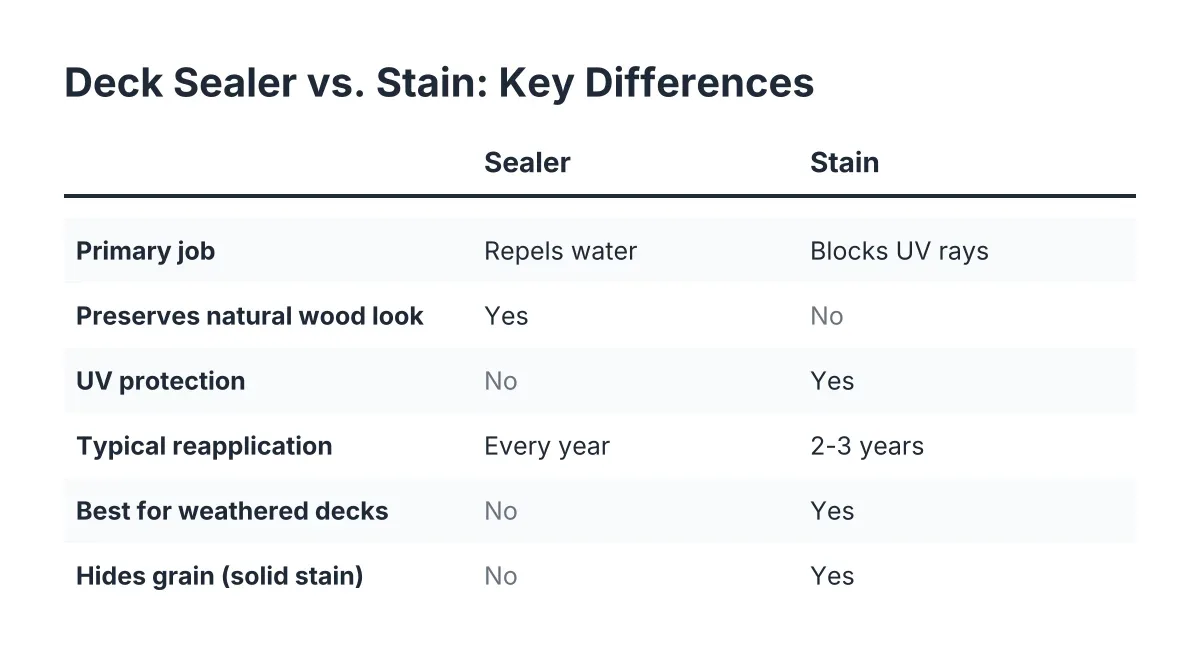
Homeowners use these two terms interchangeably, but they describe different products with different jobs. Understanding the difference between deck staining sealing products helps you buy the right can and set the right expectations. In short, one repels water while the other blocks sun, and most modern products try to do both at once.
What a Sealer Does
A sealer is a clear or lightly tinted waterproofing coat. Its only job is to repel water. To put it simply, a sealed board sheds rain instead of drinking it. Clear sealers preserve the natural look of new cedar or pressure-treated pine, which is why many homeowners choose them for a brand-new deck. The tradeoff is UV protection: clear sealers offer little defense against sunlight, so the wood still grays over time. Additionally, clear products break down faster, often needing reapplication every year in full sun.
What a Stain Does
A stain adds pigment, and pigment is what blocks UV rays. More pigment means more protection. Transparent stains show the most grain and offer the least defense. Semi-transparent stains hit the middle ground that most Cincinnati homeowners prefer, showing wood character while blocking a meaningful amount of UV. Solid stains behave almost like paint, hiding the grain completely but lasting the longest. Most quality exterior stains today combine stain and sealer in one product, so a single application handles both water and sun.
Which Combination Fits Cincinnati Weather
For our climate, an oil-based or hybrid semi-transparent stain with sealer is the workhorse choice. It penetrates deep enough to resist freeze-thaw pressure, carries enough pigment to slow UV graying, and handles humidity better than film-forming products. That said, solid stains earn their place on older decks. If your boards already show weathering, cracks, or previous coating failures, a solid stain hides those flaws and typically lasts four to five years here. Avoid cheap film-forming coatings that sit on top of the wood, because Cincinnati's moisture cycle gets underneath them and they peel in sheets within a season or two. Whatever you choose, apply it when boards are fully dry and temperatures sit between 50 and 85 degrees, which usually means late spring or early fall in Southwest Ohio.
To help narrow the decision, keep these general guidelines in mind when picking a product:
- New cedar or premium wood you want to show off: choose a clear or lightly tinted sealer to preserve grain, and expect to reapply annually.
- Standard pressure-treated lumber in normal sun: choose a semi-transparent oil-based or hybrid stain-sealer combo for the best balance of protection and appearance.
- Older, weathered, or previously coated decks: choose a solid stain to hide imperfections and extend the interval between recoats.
- Heavily shaded or damp decks: choose a product with a mildewcide additive regardless of pigment level.
How Often to Reseal a Deck: A Cincinnati Maintenance Schedule
National advice says to reseal every two to three years. That range is a starting point, but your actual schedule depends on sun exposure, drainage, tree cover, and how your deck came out of last winter. Here is how to build a schedule that fits your home instead of a national average.
The Annual Rhythm
Every spring, walk your deck after the last hard freeze. Look for graying boards, lifted grain, popped fasteners, and soft spots near posts and stairs. Then run the water test: sprinkle water on a few high-traffic boards. If it beads, your seal is holding for another season. If it soaks in within a minute or two, put staining on the calendar. Each fall, clear leaves and debris from between boards, because trapped organic matter holds moisture against the wood all winter. This means two short inspections a year, plus a full clean-and-stain roughly every two to three years for horizontal surfaces. Railings and vertical surfaces shed water better, so they often stretch to four or five years between treatments.
Staining a New Wood Deck
New decks need patience before their first coat. Pressure-treated lumber arrives saturated with preservative solution, and stain cannot penetrate wet wood. For example, a deck built in early summer usually needs one to three months of drying before it will accept stain, sometimes longer in a humid Cincinnati summer. Use the same water test to check readiness: once water absorbs instead of beading, the wood is ready. Skipping this wait is the most common new-deck mistake we see, and it leads to blotchy, peeling results that undercut the whole point of deck staining sealing in the first place.
When Staining Is No Longer Enough
Stain protects sound wood, but it cannot fix structural problems. The North American Deck & Railing Association estimates about 30 million decks in the United States are beyond their useful life and need repair or replacement. With this in mind, treat your spring inspection as a safety check too. Wobbly railings, rusted hardware, rot at the ledger board, or posts that flex underfoot signal issues that no coating will solve. In those cases, resurfacing or targeted repair is the honest answer, and it often costs far less than homeowners expect when the framing underneath is still sound.
Ready to Get Started?
If your deck is due for staining, showing its age, or overdue for a professional once-over, we can help you sort out what it actually needs. As Cincinnati deck specialists, we handle everything from deck staining and sealing to full resurfacing and replacement, all built around how Hamilton County weather treats wood. Reach out for a straightforward assessment and a plan that fits your deck, your budget, and our climate.