Composite Decking Installation Terms Explained: A Plain-English Glossary
If you are a Cincinnati homeowner comparing deck quotes, this composite decking installation glossary puts the jargon in plain English. Each entry gives you a short, standalone definition, then explains why the term matters when you read a quote or talk to a deck builder. Use it to understand what you are paying for, ask sharper questions, and spot gaps before work starts. No sales pitch, just the words of the trade explained the way a local builder would over the phone.
- Composite Decking: boards made from wood fibers and plastic
- Capped Composite: boards wrapped in a protective shell
- PVC Decking: all-plastic boards, no wood content
- Deck Board Profile: the shape and edges of a board
- Hidden Fasteners: clips that hide the screws
- Fascia Board: the trim that covers deck edges
- Picture Framing: a border of boards around the deck
- Substructure (Framing): the skeleton under the deck boards
- Joists and Joist Spacing: the beams boards rest on, and how far apart
- Ledger Board: the board that ties the deck to your house
- Footings and Frost Depth: the concrete anchors below the frost line
- Flashing: the barrier that keeps water out of your house wall
- Deck Resurfacing: new boards on an existing frame
- Building Permit: the city or county sign-off for your project
- Setbacks: how close to the property line you can build
- Load Capacity: how much weight the deck can safely hold
- Linear Foot vs. Square Foot: two ways quotes measure your deck
- Manufacturer Warranty: the coverage that comes with the boards
Materials and Boards
These are the terms you will meet first when researching composite decking installation, because they describe what the deck is actually made of.
Composite Decking and Installation Choices
Composite decking is a board made from a blend of wood fibers and recycled plastic, designed to look like wood without the yearly staining and sealing. For Cincinnati homes, that matters because our wet springs and freeze-thaw winters are hard on bare wood. Composite boards resist rot, splintering, and insect damage, which is why many homeowners choose them over treated wood decking despite the higher upfront cost. If you want to understand how that cost breaks down, our guide to composite decking installation cost walks through the main factors. Learning composite decking installation glossary terms helps you compare how builders approach each step of the job.
Capped Composite
Capped composite is a composite board wrapped in a tough outer shell, usually on three or four sides, that protects the core from moisture and fading. Most modern boards from major brands are capped; older uncapped boards stained and faded faster. When a deck contractor specifies capped boards, that is a good sign for long-term looks. Ask whether the cap covers all four sides, since fully capped boards handle standing moisture better.
PVC Decking
PVC decking is a board made entirely of plastic, with no wood fibers at all. It weighs less than composite, shrugs off moisture completely, and tends to cost more. It comes up often around pools, where a pool deck sees constant splashing. If a quote lists PVC instead of composite, that usually explains a higher material line, not padding.
Deck Board Profile
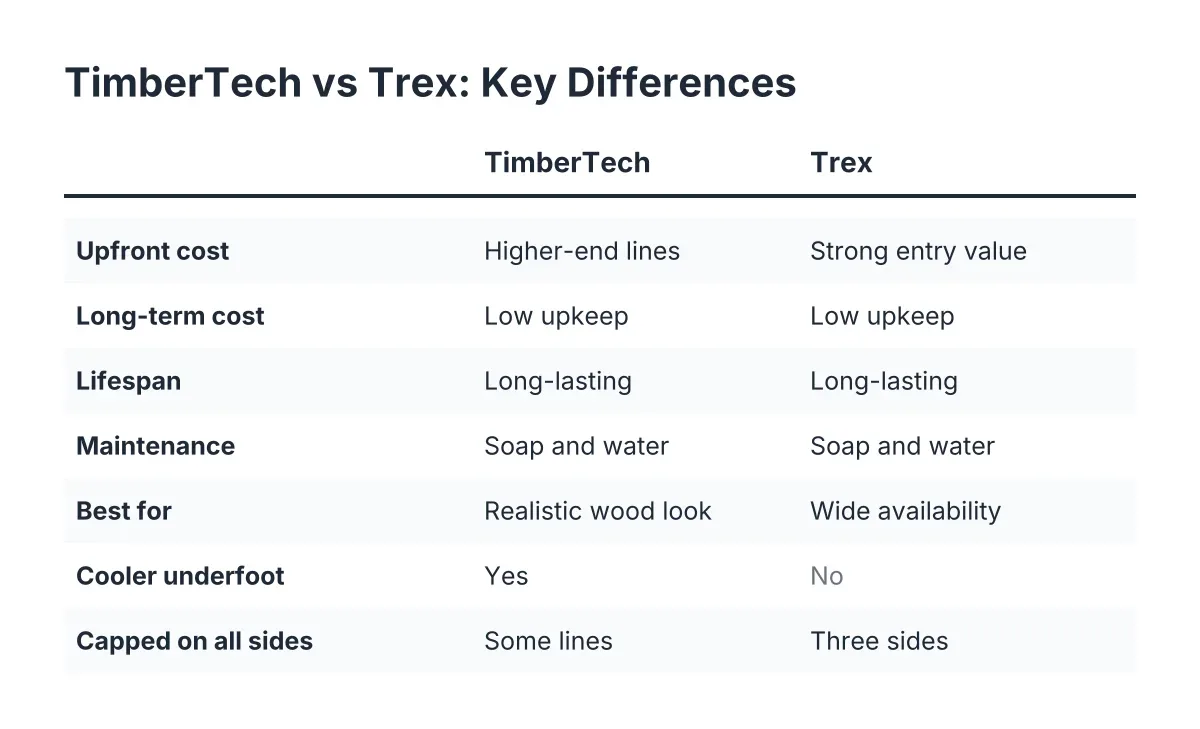
A deck board profile is the shape of the board's cross section, including whether its edges are square or grooved. Grooved boards accept hidden fastener clips; square-edge boards get face-screwed or used for borders and stairs. This matters because your fastening method and your board profile have to match. A careful quote will name the profile, not just the brand and color. Brands handle profiles differently, which is one reason homeowners compare TimberTech vs. Trex before choosing.
Hidden Fasteners
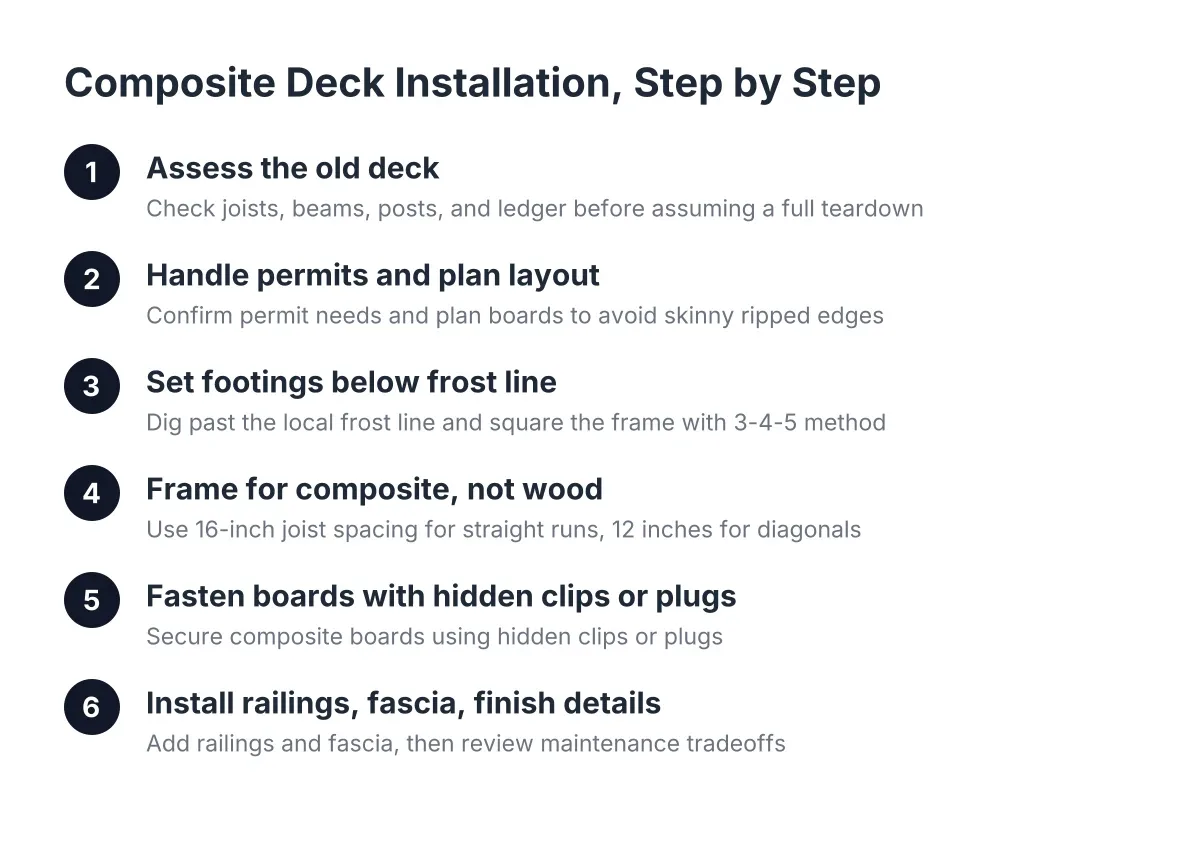
Hidden fasteners are clips that attach deck boards to the frame from the side, so no screw heads show on the walking surface. They give the deck a cleaner look and remove the small dimples where face screws can collect water. They add some labor and material cost, so check whether your quote includes them or assumes face screws. Either method is legitimate; you just want to know which one you are buying.
Fascia Board
A fascia board is the trim board that covers the exposed outer edges of the deck frame. It hides the rough framing lumber and gives the deck a finished face. Composite fascia matched to your deck boards costs more than painted wood but never needs repainting. If fascia is missing from a quote, the sides of your frame will stay exposed, so ask.
Picture Framing
Picture framing is a design detail where a border of deck boards runs around the perimeter, framing the main field of boards like a picture. It hides the cut ends of boards and sharpens the look of the deck. It requires extra blocking in the frame underneath, so it adds labor. If two quotes differ and one includes picture framing, that detail can explain part of the gap.
Structure and Installation Glossary
The boards are what you see, but the structure underneath decides how long the deck lasts. This is where Ohio weather earns its keep in the planning conversation.
Substructure (Framing)
A substructure is the frame of posts, beams, and joists that supports the deck boards, usually built from treated wood even under a composite deck. Composite boards can outlast a weak frame, so the substructure deserves as much attention as the surface. When you compare quotes for composite decking installation, ask what lumber the frame uses and how it is protected from moisture. A deck is only as good as what you cannot see.
Joists and Joist Spacing
Joists are the parallel framing boards that deck boards rest on, and joist spacing is the distance between them, measured center to center. Composite boards flex more than wood, so manufacturers specify maximum spacing, commonly tighter for diagonal patterns. If spacing is too wide, boards feel bouncy and warranties can be voided. A builder who mentions spacing requirements is reading the installation specs, which is what you want.
Ledger Board
A ledger board is the framing board bolted to your house that supports one side of an attached deck. It is the most common failure point on badly built decks, because a poorly attached or unflashed ledger lets water rot the house framing. Ask how the ledger will be fastened and flashed. A builder with a clear answer here is worth listening to.
Footings and Frost Depth
Footings are the concrete anchors in the ground that hold up the deck posts, and frost depth is how deep they must go to sit below the soil that freezes in winter. In greater Cincinnati, freeze-thaw cycles can heave shallow footings, lifting and tilting a deck over time. Local code sets the required depth, so check with your building department or let your deck builder handle it. Footing count and depth are a real line item, not filler.
Flashing
Flashing is a thin barrier of metal or waterproof membrane installed where the deck meets the house, directing water away from the wall. Without it, rain works behind the ledger board and rots the house framing out of sight. Good flashing is cheap insurance and should appear in any attached-deck scope. If a quote never mentions it, ask.
Deck Resurfacing
Deck resurfacing means replacing the walking boards and railing on an existing deck while keeping the original frame. It can be a smart middle path when the substructure is sound but the surface is worn. The catch is the frame must truly be sound, and joist spacing must suit composite boards. An honest deck contractor will inspect the frame before promising a resurface instead of a full rebuild.
Paperwork, Pricing, and Fine Print
Building Permit
A building permit is the official approval from your city or county that lets you build the deck and triggers inspections along the way. In the Cincinnati area, most new decks of any real size need one, and the inspection protects you by checking footings and framing. A builder who handles permits as part of the job saves you trips to the counter. Be cautious of anyone who suggests skipping the permit.
Setbacks
A setback is the minimum distance your deck must keep from property lines, easements, or other features, set by local zoning rules. Setbacks can shrink or reshape the deck you had in mind, especially on smaller Cincinnati lots. Your HOA may add its own rules on top of zoning. Sorting this out before design work avoids redrawing plans later.
Load Capacity
Load capacity is the amount of weight a deck is engineered to hold safely, including people, furniture, and snow. It drives framing decisions like beam size and footing count. Hot tubs and heavy planters need extra support designed in from the start, not added after. Mention anything heavy during planning so the frame is built for it.
Linear Foot vs. Square Foot
A linear foot measures length along a line, while a square foot measures area, and deck quotes use both. Railing, fascia, and stair treads are priced by the linear foot; decking surface is priced by the square foot. Mixing the two up is the fastest way to misread a quote. When comparing bids, make sure both builders measured the same deck the same way.
Manufacturer Warranty
A manufacturer warranty is the board maker's promise to cover defects like excessive fading or staining for a set period. It covers the product, not the labor to replace it, and it depends on the boards being installed to the manufacturer's specs. That is one reason installation details like joist spacing and fasteners matter. Ask what the warranty covers, what it excludes, and who registers it.
Using These Terms
With this composite decking installation glossary in hand, you can read a deck quote line by line instead of skimming to the total. You will know why one bid lists hidden fasteners and picture framing while another does not, and you can ask about footings, flashing, and permits before anyone digs. That is the whole point: fewer surprises, better questions, and a deck built right for Cincinnati weather.
If you need deck building and installation, Cincinnati Deck Pros can help.
Prefer to talk it through? Call (513) 613-3364 — a quick call is usually the fastest way to get a straight answer for your situation.