Composite Decking Installation — Complete Guide
Composite deck installation is one of the biggest decisions you'll make when planning a new outdoor space, and it's not as simple as picking a color from a Trex sample board. This guide covers the full picture: what composite decking actually costs in the Cincinnati market, how the installation process differs from wood, and how boards from brands like Trex and TimberTech hold up through Ohio freeze-thaw winters. You'll also get straight answers on lifespan, maintenance, and resale value, without the brand-pushing you'll find on manufacturer sites. By the end, you'll know whether composite is the right call for your project and what to expect before the first footing gets poured.
What You'll Find in This Guide
Coming soon — we're building out this topic cluster.
Prefer to have a pro handle it? Composite decking installation is one call away.
What Composite Deck Installation Costs in Cincinnati
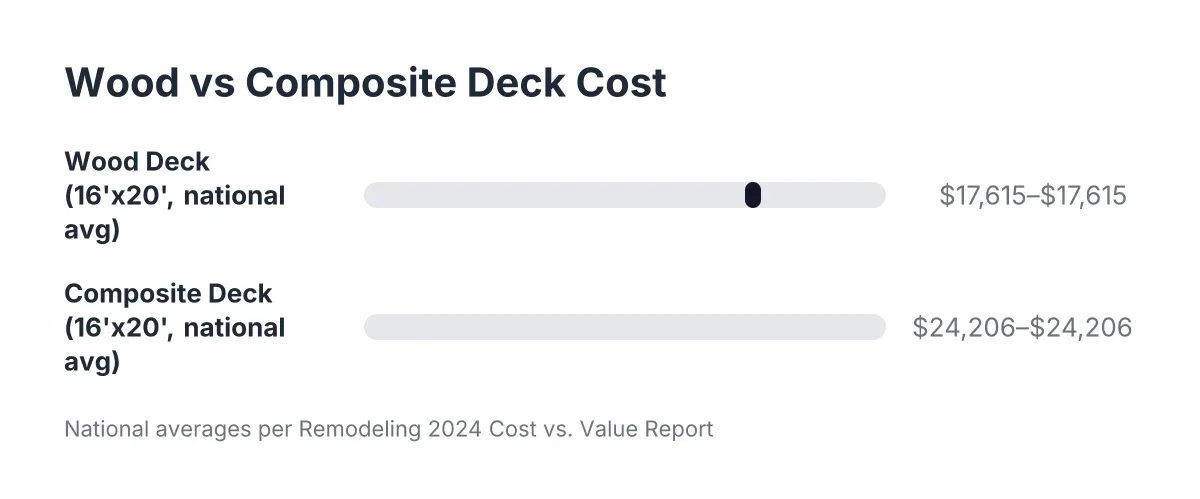
Let's start with the number everyone wants first. Nationally, a 16'x20' pressure-treated wood deck runs an average of $17,615, while the same deck in composite costs $24,206, per the Remodeling 2024 Cost vs. Value Report. That gap of roughly $6,500 is the premium you pay for a low-maintenance surface. In practice, Cincinnati projects land in a similar range, though your final price depends on site conditions, elevation, and design choices.
Here's what actually drives the cost of a composite build in Hamilton County. First, the boards themselves. Entry-level composite lines cost meaningfully less per linear foot than premium capped boards with realistic wood-grain finishes. Second, the frame. Almost every composite deck still sits on a pressure-treated wood substructure, so lumber prices affect your quote even on a "composite" project. Third, footings. Ohio's frost depth requires footings that reach below the frost line, and hillside lots common on Cincinnati's west side and river neighborhoods can push excavation costs up fast.
Beyond materials, labor makes up a significant share of the total. Composite boards install with hidden fasteners on most lines, which takes more time than face-screwing wood planks. Additionally, composite requires tighter gapping tolerances because the boards expand and contract with temperature swings. A crew that rushes this step in July will hand you buckled boards by January.
Where Composite Saves You Money Over Time
The upfront premium is real, but so is the long-term math. A wood deck in Cincinnati needs staining or sealing every two to three years to survive our wet springs and freeze-thaw winters. Over 15 years, that maintenance adds up to thousands of dollars, or dozens of weekends of your own labor. Composite skips nearly all of it. You wash it, and that's about the extent of the routine.
On resale, the picture is more nuanced. The same Cost vs. Value Report puts wood decks at an 83% return and composite at roughly 68% nationwide. However, resale return isn't the whole story. According to the National Association of Realtors, 81% of homeowners say they enjoy their homes more after adding a deck. If you plan to stay in your home for a decade or more, the years of skipped maintenance often outweigh the resale gap.
How the Composite Deck Installation Process Works
A composite deck installation follows the same broad sequence as a wood build, but several steps demand more precision. Knowing the sequence helps you vet contractor quotes and spot corner-cutting before it happens.
Everything starts with design and permitting. In Hamilton County and most Cincinnati suburbs, a new deck attached to your home requires a building permit, and detached decks above a certain height do too. Your plans need to show footing locations, ledger attachment details, and railing heights. Additionally, many neighborhoods carry HOA rules and setback requirements that limit how close your deck can sit to property lines. You can review Ohio's residential building requirements through the Ohio Board of Building Standards, which governs the code your local inspector enforces.
Next comes the substructure, and this is where composite projects diverge from wood. Composite boards flex more than lumber, so most manufacturers require joists spaced 16 inches on center, and 12 inches for diagonal patterns. If a contractor plans to lay composite over an old frame built with 24-inch spacing, that's a red flag. The frame also needs joist tape over each board to keep water from rotting the wood beneath your maintenance-free surface.
Footings, Frost Depth, and Why Cincinnati Winters Matter
Footings deserve their own conversation here. Southwest Ohio's frost line means your footings must extend deep enough that freezing ground can't heave them upward. When footings sit too shallow, freeze-thaw cycles lift and drop the posts season after season. As a result, you get wavy deck surfaces, stressed connections, and railing posts that loosen over time. This is one of the most common failures we see when we're called to repair or replace decks built by general handymen.
Once the frame passes inspection, the boards go down. Composite installs with hidden clip fasteners on grooved boards, which creates that clean, screw-free surface. However, installers must leave manufacturer-specified gaps at board ends and against the house. Composite expands lengthwise in heat and contracts in cold, far more than wood does. In a climate that swings from 95-degree summers to single-digit winters, correct gapping is the difference between a deck that lasts 25 years and one that buckles in three.
Composite Brands, Lifespan, and the Honest Tradeoffs
You've probably narrowed your search to Trex or TimberTech already, since those two dominate the market. Both make excellent boards, and both make entry-level lines that perform very differently from their premium products. To put it simply, the brand name matters less than the specific product line and the quality of the installation underneath it.
Trex builds its boards from roughly 95% recycled material with a polyethylene cap. TimberTech offers both composite and full PVC lines, and its PVC boards resist heat and moisture especially well, which makes them a strong pick for pool decks. Beyond those two, brands like Deckorators and Fiberon compete hard on price and warranty terms. The composite category keeps growing for a reason. Business Research Insights values the global composite decking market at USD 4.195 billion in 2025, with projected growth of about 7.37% annually through 2034. That growth means more product options each year, but also more low-quality boards entering the market. A specialist who installs these products weekly can tell you which lines hold up in Ohio conditions and which ones fade or stain.
How Long Composite Actually Lasts
Most quality composite lines carry 25 to 50-year warranties against fading, staining, and structural defects. In practice, expect a well-installed composite deck in Cincinnati to look good for 25 to 30 years with minimal effort. Compare that to pressure-treated wood, which typically needs board replacement within 10 to 15 years here, even with diligent staining.
That said, the warranty covers the boards, not the frame. Because the substructure is still wood, its lifespan depends on flashing, joist tape, and drainage details your installer handles during the build. A composite surface on a rotting frame is still a failed deck.
The Tradeoffs Nobody Puts in the Brochure
Composite isn't perfect, and you deserve the full list. Dark composite boards get hot in direct summer sun, hot enough to bother bare feet on a south-facing deck. Composite also costs more upfront, and its resale return trails wood, as the Cost vs. Value numbers above show. Additionally, scratches in composite can't be sanded out the way wood can, though capped boards resist scratching far better than early-generation products did. Finally, composite is heavier than wood, which is another reason proper framing and footings matter so much.
For most Cincinnati homeowners who plan to keep their home, the tradeoffs favor composite. You trade a higher initial invoice for decades of weekends you don't spend sanding, staining, and sealing.
Choosing an Installer for Your Composite Deck
The board brand gets all the attention, but the installer determines whether your deck reaches its warranty lifespan. Composite deck installation punishes shortcuts in ways wood forgives. Wrong joist spacing, skipped joist tape, shallow footings, and tight gapping all produce failures that surface one or two winters later, long after the check cleared.
With this in mind, ask any contractor a few pointed questions. Ask what joist spacing they use for composite, and for diagonal patterns. Ask how deep they pour footings and whether they pull permits themselves or leave that to you.Additionally, ask whether they're certified installers for the brand they're quoting, since Trex and TimberTech both run installer programs, and certified installs often carry stronger warranty coverage. Finally, ask to see a composite deck they built at least three winters ago. Any deck looks great on day one. A deck that looks great after three freeze-thaw cycles tells you something real.
Local experience matters more here than in most trades. A national franchise crew or a general contractor who builds two decks a year won't know which Cincinnati suburbs require stamped drawings, how Hamilton County inspectors interpret ledger requirements, or how hillside soil on the west side affects footing design. For example, a deck plan that sails through permitting in one township can stall for weeks in the next one over. A specialist who works these permit offices every month keeps your project moving.
Cost quotes deserve the same scrutiny. However tempting the lowest bid looks, compare what's actually included. Some quotes cover demolition of your old deck, permit fees, and railing installation. Others leave those as surprises. A detailed line-item quote from a deck specialist protects you from the change-order spiral that plagues vague estimates.
Ready to Get Started?
If you're weighing composite against wood for your Cincinnati deck project, we'll give you honest numbers for both, built from your actual site conditions rather than a national calculator. Our team designs, permits, and builds composite decks across Hamilton County, and we'll tell you plainly when composite makes sense and when it doesn't. Reach out for a consultation, and let's figure out the right deck for your home and your budget.