How to Use a Deck Calculator to Sanity-Check Deck Quotes in Cincinnati
If your deck is 15 or 20 years old and the boards feel soft underfoot, you have two problems at once. The first is safety. The second is money, because you have no idea whether fixing it should cost a few thousand dollars or five times that. A deck calculator can help, but only if you know what to feed it and what it leaves out. Most online tools count boards and screws. They do not count frost-depth footings, Hamilton County permit requirements, or the labor difference between a ground-level platform and a second-story rebuild. This guide walks you through pricing a Cincinnati deck project step by step, so when quotes arrive you can tell a fair number from a padded one.
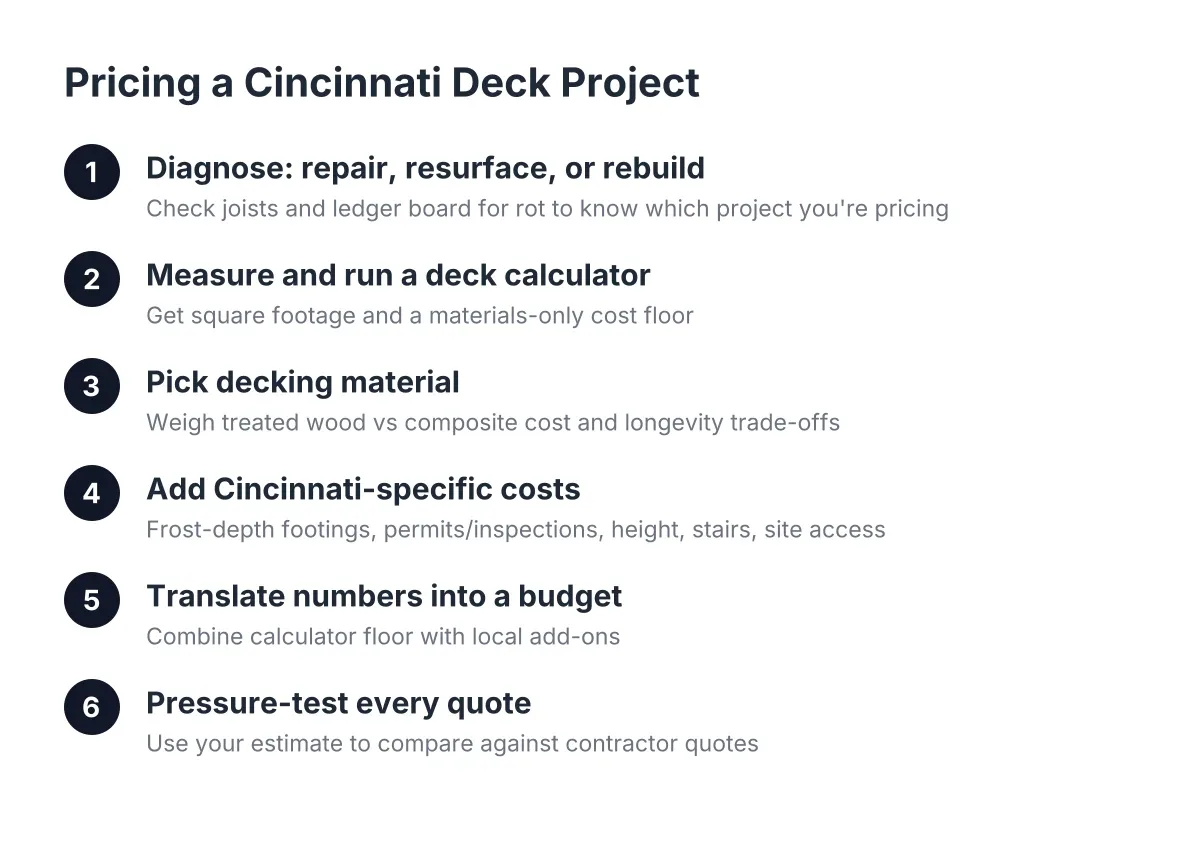
Step 1: Figure Out Whether You Need a Repair, a Resurface, or a Rebuild
Before any numbers matter, you have to know which project you are pricing. These three jobs have wildly different costs, and pricing the wrong one is how homeowners end up either overpaying or getting burned by a lowball quote.
Here is the honest breakdown a good deck contractor should walk you through:
- Deck repair makes sense when the damage is isolated: a few rotted boards, a loose deck railing, or one failing post. The frame underneath is still sound.
- Deck resurfacing fits when the joists and footings are solid but the decking and railing on top are worn out. The crew keeps the frame and replaces everything you see and touch.
- Full deck demolition and replacement is the answer when the structure itself is failing: rotted joists, heaving footings, or a ledger board pulling away from the house.
How do you tell which one you have? Go underneath the deck with a screwdriver. Press it into the joists and the ledger board where the deck attaches to your house. If the wood is firm, resurfacing may be on the table. If the screwdriver sinks in, or you see dark staining and spongy wood along the frame, budget for a rebuild. Springy boards on top with a solid frame below usually means resurfacing; springy boards with a soft frame means teardown.
This matters for your wallet. Resurfacing reuses the most expensive hidden parts of the deck, the frame and footings, so you pay mostly for surface materials and labor. A rebuild pays for everything twice: demolition of the old deck, then a new structure from the ground up.
Step 2: Measure Your Deck and Run a Deck Calculator for Materials
Measure the deck you have, or sketch the one you want, in simple length and width. Multiply for square footage. Size is the single biggest driver of total project cost, because every added square foot adds decking, framing, fasteners, and labor hours.
Next, run those dimensions through a free deck calculator from a decking manufacturer or a home improvement retailer. These tools estimate board counts, joist layouts, and sometimes a rough materials cost per square foot. That is useful. It gives you a floor, the minimum your project can cost in raw materials.
However, understand what a deck cost calculator does not include:
- Labor, which often matches or exceeds materials on a professional build
- Demolition and haul-away of your existing deck
- Permit fees and inspection trips
- Footings dug below the Ohio frost line, which require concrete, digging, and inspection
- Stairs, railing, fascia, and finishing details
One practical tip while you are in a materials calculator: decks designed around standard board lengths, like 12, 16, or 20 feet, waste less lumber. Odd dimensions mean offcuts you pay for and throw away. If your plan is 13 feet deep, ask whether 12 or 14 changes the material math.
Step 3: Pick Your Decking Material and Price the Trade-Off
Material choice is the second biggest cost lever after size, and it is where most homeowners face a real trade-off. On a fixed budget, you can usually get a bigger deck in treated wood decking or a smaller deck in composite decking. Getting both size and premium material costs more; there is no way around it.
For a sense of national scale, the Remodeling 2024 Cost vs. Value Report put a 16-by-20-foot pressure-treated wood deck at an average of $17,615, and the same deck in composite at $24,206. Your Cincinnati numbers will differ with site conditions and design, but the gap between wood and composite is the point: composite runs meaningfully higher upfront.
The trade-off cuts the other way over time. Treated wood needs staining and sealing every few years, and in greater Cincinnati's freeze-thaw climate it weathers hard. Composite brands like Trex and TimberTech cost more on day one but skip the refinishing cycle. If you plan to stay in the house ten more years, composite often earns its premium. If you are selling soon, wood may pencil out better, especially since the 2025 Cost vs. Value Report from Remodeling Magazine and Zonda shows a wood deck recouping about 95% of its cost at resale nationally, versus about 89% for composite.
One more pricing detail worth knowing: wider premium boards cost more than standard-width boards, and finishing choices like picture-frame borders or a double-step fascia add labor beyond the base material. Ask what finishing style a quote includes, because two quotes for "composite decking" can describe different decks.
Step 4: Add the Cincinnati-Specific Costs a Deck Calculator Misses
This is where local knowledge separates a realistic budget from a guess. A generic deck calculator has no idea your deck sits in Hamilton County, and these items are precisely where quotes diverge.
Frost-Depth Footings
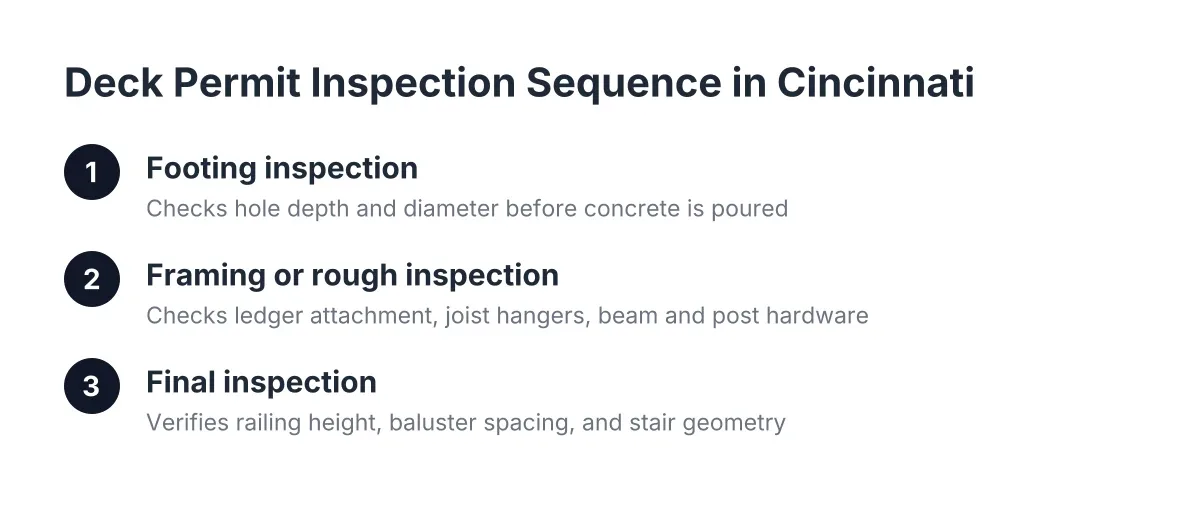
Ohio winters push frost deep into the ground, and footings that stop short of the frost line will heave and shift. According to Decks.com, structural posts like deck footings must be dug below the local frost line rather than relying on general above-grade rules. Deeper holes mean more digging, more concrete, and sometimes an inspection before the crew can pour. Footings also have to be sized for the load they carry, and larger or unusual decks sometimes need a structural engineer's calculations. That is a line item, not a scam.
Permits and Inspections
Most deck builds and full rebuilds in the Cincinnati area require a permit, with the path running through the city or Hamilton County depending on where you live. Permit fees vary by jurisdiction and project scope, so ask your deck builder to spell out who pulls the permit and whether the fee is in the quote. If you live in a neighborhood with an HOA, check setback and design rules before you fall in love with a plan.
Height, Stairs, and Site Access
A deck eight feet off the ground costs more to build than the same deck at grade. Crews need ladders or scaffolding, and every foot of height adds stair treads, each with its own material and labor. Tight backyard access, slopes, and old concrete to remove all add time, and time is money on a labor job.
Step 5: Translate the Numbers Into a Working Budget
Now put the pieces together. Start with your deck calculator materials estimate, then layer on the categories it skipped: labor, demolition if you are replacing, permits, footings, stairs, and railing. Thinking in deck cost per square foot helps you compare quotes of different sizes, but make sure every quote covers the same scope before you compare the per-foot numbers.
For a concrete picture, suppose a homeowner in Anderson Township has a 20-year-old, 14-by-16-foot wood deck with soft boards but a frame that passes the screwdriver test. In that scenario, a resurfacing project in treated wood might land in the low-to-mid four figures for materials plus labor, while the same footprint resurfaced in composite would run higher, and a full teardown and rebuild could reach two to three times the resurfacing price. Those are illustrative ranges, not quotes; the point is the spread between the three options, which is exactly why Step 1 comes first.
If you are selling the house, weigh the spend against what buyers see. The National Association of Realtors found the average new wood deck project cost $16,900 nationally in its 2023 Remodeling Impact Report, and NAR reports that 81% of homeowners say they enjoy their homes more after adding a deck. For a pre-listing seller, though, a clean resurface that passes inspection usually beats a premium rebuild the next owner would have designed differently. Understanding the full range of deck building costs before you talk to anyone keeps the agent's "just make it safe and presentable" advice grounded in real numbers.
Step 6: Use Your Estimate to Pressure-Test Every Quote
You now have a working budget. The last step is using it when contractors show up. A fair quote in 2026 should itemize, not hand you one mystery number, which is the exact experience that burned you last time.
Ask every deck contractor these three questions:
- What exactly is included? Demolition, haul-away, footings, permits, railing, stairs, and fascia should each be named. "New deck, $X" is not a quote; it is a guess you cannot verify.
- Why this scope? If they recommend a full rebuild, ask them to show you the failing framing. An honest builder will crawl under the deck with you and point at the rot. If the frame is sound and they still push a teardown, get a second opinion.
- Who handles the permit and inspections? The answer should be specific to your city or Hamilton County, not a shrug.
A quote that lands near your calculator-plus-local-costs estimate is probably honest. A quote far below it is usually missing scope, skipping permits, or planning footings that will not survive an Ohio winter. Additionally, a quote far above it should come with an explanation you can see with your own eyes, like a deteriorated ledger board or a steep site.
One caution on doing it yourself: replacing a few deck boards or tightening railing hardware is reasonable DIY territory. Anything touching the frame, footings, or ledger attachment belongs with a licensed deck builder, because those are the failures that drop decks full of people. If your boards feel springy right now, keep gatherings off the deck until someone qualified has looked at the structure.
Get a Local Number Instead of a National Average
A deck calculator gets you a materials floor. The steps above get you a realistic Cincinnati budget. The only thing left is a real assessment of your actual deck, because no online tool can tell you whether your frame will carry new boards or needs to come down.
If you are in greater Cincinnati and staring at a deck you no longer trust, reach out to us for an honest evaluation. We will tell you whether repair, deck resurfacing, or full replacement fits your situation, walk you through the numbers line by line, and give you an estimate you can check against everything you just learned.
If you need deck building and installation, Cincinnati Deck Pros can help.
Prefer to talk it through? Call (513) 613-3364 — a quick call is usually the fastest way to get a straight answer for your situation.