Deck Building Costs — Complete Guide
Deck building costs vary more than most Cincinnati homeowners expect, and the gap between a lowball estimate and a realistic quote can run into thousands of dollars. Size, materials, labor, footings, and permits all move the number, and composite deck cost differs meaningfully from treated wood once you look past the sticker price. This guide breaks down every major factor that drives the cost to build a deck in the Cincinnati area, from price per square foot to Hamilton County permit fees. By the end, you'll have a realistic budget range and the knowledge to sanity-check any quote a contractor hands you.
What You'll Find in This Guide
Coming soon — we're building out this topic cluster.
What Drives Deck Building Cost Per Square Foot
Most contractors quote decks by the square foot, and that single number hides a lot of moving parts. In the Cincinnati market, a straightforward treated-wood deck typically lands at the lower end of the range, while a multi-level composite build with custom railing sits at the top. Understanding what pushes that number up or down helps you compare quotes on equal footing.
Size matters, but not the way you might think. A larger deck usually costs less per square foot because fixed costs like permits, footings, and mobilization spread across more area. For example, doubling a deck from 150 to 300 square feet rarely doubles the total price. That said, a bigger footprint means more posts and more frost-depth footings, which is where Cincinnati differs from milder climates.
Why Cincinnati Footings Cost More Than You'd Guess
Ohio's freeze-thaw cycles force footings below the frost line, which sits at roughly 30 to 36 inches in Hamilton County. As a result, every support post requires a deeper hole, more concrete, and more labor than the same deck would need in a warmer state. Sloped lots, common in neighborhoods like Mount Lookout and Delhi, add further excavation and taller posts. If your yard drops away from the house, budget for that before you fall in love with a design.
Height and complexity drive cost too. A ground-level platform deck is the cheapest build per square foot. However, a second-story deck adds structural posts, longer stair runs, and required guardrails. Multi-level designs, built-in benches, pergolas, and wraparound stairs each add labor hours that show up in your quote. Curved edges and diagonal decking patterns increase material waste, sometimes by 10 to 15 percent.
Beyond the structure itself, railing is a line item people consistently underestimate. Railing runs by the linear foot, not the square foot. So a long, narrow deck can carry a surprisingly high railing bill compared to a square deck of the same area. Aluminum and composite railing systems cost several times more than basic wood balusters. With this in mind, ask every contractor to break out railing as its own line so you can compare apples to apples.
Composite Deck Cost vs. Treated Wood: The Real Numbers
Material choice is the single biggest budget decision you'll make, and it's where most homeowners get stuck. Pressure-treated wood costs the least upfront. Composite brands like Trex and TimberTech cost more on day one but cut maintenance for decades. To put it simply, you're choosing between a lower purchase price and a lower cost of ownership.
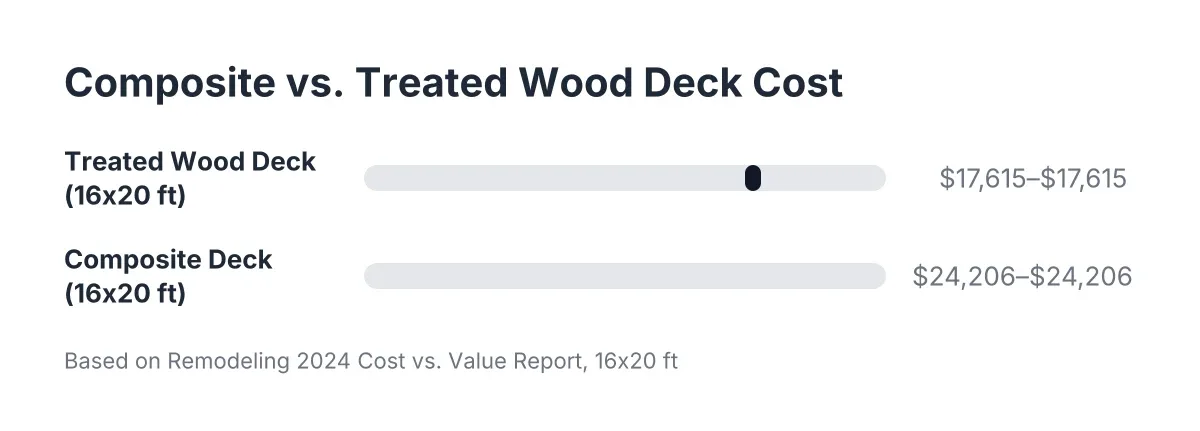
The national data backs up the size of that gap. According to the Remodeling 2024 Cost vs. Value Report, a 16-by-20-foot pressure-treated wood deck averages $17,615 with an 83% return at resale, while the same deck in composite runs $24,206 with a 68% return. Resale figures shift year to year, though. For instance, the 2025 Cost vs. Value Report from Remodeling Magazine and Zonda shows wood recouping about 95% of its cost and composite about 89%. Either way, the pattern holds: composite deck cost runs roughly 30 to 40 percent above wood for the same footprint.
What the ROI Numbers Don't Tell You
Resale return is only part of the picture. Treated wood demands staining and sealing every two to three years, and Cincinnati's humid summers and freeze-thaw winters accelerate checking, cupping, and splinters. Over a 15-year span, those maintenance costs and weekends of labor narrow the gap considerably. Composite boards need soap-and-water cleaning and little else. Additionally, premium composite lines carry 25-to-50-year warranties that treated lumber can't match.
There's also a quality-of-life factor the spreadsheets miss. According to the National Association of Realtors, 81% of homeowners say they enjoy their homes more after adding a deck. That enjoyment doesn't depend on which material you pick. However, it does depend on the deck holding up, which is why material choice matters more in a freeze-thaw climate than in Phoenix or San Diego.
Within composite itself, pricing varies by tier. Entry-level lines from Trex and TimberTech sit closest to premium wood pricing, while top-tier boards with realistic grain and enhanced heat resistance cost significantly more per square foot. Consequently, "composite" on a quote tells you almost nothing until you see the specific product line. Always ask which board, which color family, and which fastening system the price includes. Hidden fasteners look cleaner but add cost, and some boards require them for warranty coverage.
Permits, Labor, and the Line Items Quotes Leave Out
Materials get the attention, but labor typically accounts for 40 to 60 percent of your total deck budget. In practice, this is where quotes diverge the most. A crew that builds decks every week works faster and makes fewer structural mistakes than a general contractor who builds two decks a year. Therefore, a slightly higher labor rate from a specialist often produces a lower total cost once you factor in speed and callbacks.
The Cincinnati Permit Path
Nearly every attached deck in the Cincinnati area requires a building permit. If you live in the City of Cincinnati, you'll go through the city's Buildings and Inspections department. Homeowners in unincorporated townships work with Hamilton County Building Inspections instead, and suburbs like Blue Ash and Anderson Township have their own processes. Permit fees for a typical residential deck generally run in the low hundreds of dollars, a small line item that protects you at resale and insurance time. For structural requirements like footing depth, ledger attachment, and guardrail height, most local jurisdictions follow the Residential Code of Ohio, which you can review through the Ohio Board of Building Standards. A reputable contractor pulls the permit and schedules inspections as part of the job. If a bid excludes permits, treat that as a red flag, not a savings.
Line Items to Look For on Every Quote
Beyond permits, several costs routinely go missing from lowball estimates. Watch for these on any written quote:
- Demolition and haul-away of an existing deck, which can add four figures for a large structure
- Footings and concrete, priced for actual frost depth rather than a generic assumption
- Railing and stairs broken out separately from the deck surface
- Flashing and ledger hardware, the details that prevent rot at the house connection
- Site access issues like fences, slopes, or tight side yards that slow the crew down
HOA rules add another wrinkle in many Cincinnati suburbs. Some associations restrict deck height, color, or material, and some require design approval before the permit stage. Similarly, zoning setbacks limit how close a deck can sit to your property line. Sorting these out early costs nothing. Discovering them mid-build costs plenty, so confirm HOA and setback rules before you sign anything.
How to Build a Realistic Deck Budget Before You Request Quotes
Armed with the cost drivers above, you can set a budget range instead of a single wishful number. Start with the footprint you actually need, not the biggest deck your yard allows. Then pick a material tier, because that decision alone swings the total more than any other choice. From there, add allowances for railing, stairs, permits, and demolition if you're replacing an existing structure.
A practical approach: get your rough square footage, multiply by a low and high per-square-foot figure for your chosen material, then add 10 to 15 percent as a contingency. That cushion covers surprises like a rotted ledger board, unstable soil at a footing location, or an HOA-mandated railing upgrade. Projects that blow their budgets usually skipped the contingency, not the math.
Comparing Quotes Without Getting Burned
Once quotes arrive, compare scope before you compare totals. The cheapest bid often excludes something the others include, such as permit fees, haul-away, or a specific composite line. For this reason, ask each contractor the same set of questions. Which board and railing system does the price include? Who pulls the permit? How deep are the footings, and how many posts? What does the warranty cover, and who backs it, the manufacturer or the builder?
Also weigh timing. Cincinnati deck season peaks from April through September, and crews book out weeks or months ahead. Booking a winter or early-spring build sometimes earns better pricing and faster scheduling, since footings can go in whenever the ground allows. Meanwhile, material prices for lumber and composite shift throughout the year, so a quote older than 30 to 60 days may no longer hold.
Finally, remember why the composite deck cost premium exists at all. You're paying upfront to skip fifteen years of staining, sealing, and board replacement in a climate that punishes wood. Neither choice is wrong. However, the right choice depends on how long you'll stay in the home, how you feel about maintenance weekends, and how the numbers pencil out for your specific project. A transparent, line-item quote makes that decision easy. A vague lump-sum number makes it a gamble.
Ready to Get Started?
If you're planning a new deck in the Cincinnati area, we'll walk your property, talk through materials, and give you a line-item quote you can actually compare. As a local deck-and-patio specialist, we handle the Hamilton County permit path, frost-depth footings, and HOA requirements so nothing surprises you mid-build. Reach out for a free consultation and get a real number for your project.